
HDMI Wireless Video Transmitter for Flexible Camera Monitoring
- Videocast

- 4 days ago
- 5 min read
Modern video production requires more flexibility, mobility, and reliable monitoring. Whether you are working on a live event, corporate production, studio shoot, or outdoor broadcast, long HDMI cables can restrict camera placement and make setup more complicated.
An HDMI wireless video transmitter provides a practical solution by sending video wirelessly from a camera to a compatible receiver. This allows production teams to monitor camera feeds while giving camera operators greater freedom of movement.
What Is an HDMI Wireless Video Transmitter?
An HDMI wireless video transmitter is a device that sends the HDMI video signal from a camera or other HDMI source to a wireless receiver. The receiver can then connect to a monitor, video switcher, recording system, or streaming computer.
A basic workflow looks like:
Camera → HDMI Transmitter → Wireless Signal → Receiver → Monitor / Switcher / Recorder
This setup reduces the need for long HDMI cables and can make temporary or mobile production environments easier to configure.

How Does HDMI Wireless Video Transmission Work?
The transmitter connects to the HDMI output of a camera. It converts the incoming video signal into a wireless transmission that is received by the paired receiver.
The receiver converts the wireless signal back into an HDMI output that can be connected to professional production equipment.
This makes it possible for camera operators, directors, and production teams to monitor video without requiring a direct HDMI cable between the camera and monitoring location.
Benefits of HDMI Wireless Video Transmitters
1. Flexible Camera Positioning
Wireless transmission allows cameras to be placed in locations where long HDMI cables would be difficult to install.
This is useful for:
Live events
Conferences
Corporate productions
Stage performances
Weddings
Studio production
Education and training
Outdoor shoots
2. Reduced Cable Management
Long cables can create clutter and require additional routing. A wireless HDMI system can help create a cleaner production environment while reducing cable-related setup work.
3. Real-Time Camera Monitoring
Low-latency wireless systems allow production teams to monitor camera feeds with minimal delay. This is particularly important for live switching and camera direction.
For example, VIDEOCAST wireless systems include models designed around low-latency monitoring, while specific models support HDMI loop-out for local camera monitoring.
4. Faster Production Setup
Wireless connectivity can simplify temporary installations. Instead of planning long HDMI cable runs, teams can position the transmitter and receiver according to the requirements of the production.
5. Support for Professional Workflows
An HDMI wireless transmitter can be integrated with cameras, monitors, video switchers, streaming computers, and recording systems, depending on the model and available interfaces.
VIDEOCAST currently offers wireless systems with HDMI connectivity as well as models supporting both HDMI and SDI workflows.
HDMI Wireless Transmitter for Live Streaming
Wireless HDMI transmission can be particularly useful in live streaming environments where cameras need to move around a venue.
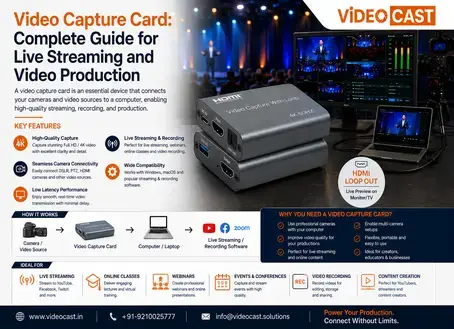
Camera → Wireless HDMI Transmitter → Wireless Receiver → Video Capture Card → Streaming Computer
The streaming computer can then process the video through software such as OBS Studio or other compatible production platforms.
This approach gives the camera operator greater mobility while keeping the camera feed available to the streaming team.
HDMI Wireless Transmitter for Multi-Camera Production
Multi-camera productions often require cameras to be positioned at different locations. Wireless transmission can help simplify connections between remote cameras and the central production area.
Depending on the equipment, multiple transmitter and receiver systems can be used as part of a larger production workflow.
Some VIDEOCAST systems also support one transmitter communicating with multiple receivers, providing additional flexibility for monitoring applications.
Key Features to Consider
Before choosing an HDMI wireless video transmitter, consider these important factors:
Transmission Range
Choose a system based on your actual production environment rather than relying only on the advertised maximum range. Walls, people, equipment, and other sources of interference can affect wireless performance.
Latency
For live production, low latency is important because the camera feed needs to reach the monitoring or switching system quickly.
Resolution Support
Check whether the transmitter supports the resolution and frame rate required by your camera. Some professional systems support 4K video, while others are optimized for Full HD workflows.
HDMI Loop-Out
An HDMI loop-out can be useful when the camera operator needs a local monitor while simultaneously transmitting the camera feed wirelessly. Certain VIDEOCAST systems provide this functionality.
Power Options
For mobile production, flexible power options such as USB-C, DC power, or camera batteries can make the system easier to use in the field.
Receiver Connectivity
Check whether the receiver provides the outputs required by your workflow, such as HDMI for monitors, switchers, or capture devices.
Where Can HDMI Wireless Video Transmitters Be Used?
Live Events
Concerts, conferences, exhibitions, and corporate events can benefit from flexible camera placement.
Video Production
Directors and camera teams can monitor camera feeds without running long cables across a production area.
Education
Lecture halls and classrooms can use wireless camera connections for presentations, recording, and streaming.
Houses of Worship
Wireless camera systems can reduce visible cable runs while allowing cameras to cover different areas of a venue.
Outdoor Production
Wireless transmission can be useful for temporary camera installations where cable routing is difficult.
How to Choose the Right HDMI Wireless Video
Transmitter
Before selecting a system, consider:
Camera HDMI output
Required video resolution
Transmission distance
Expected latency
Indoor or outdoor usage
Receiver outputs
HDMI loop-out requirements
Power source
Number of cameras
Compatibility with your switcher or streaming setup
For example, VIDEOCAST current wireless range includes HDMI systems as well as professional HDMI/SDI models designed for different production requirements.
Conclusion
An HDMI Wireless Video Transmitter is a valuable solution for production teams that need flexible camera monitoring without relying on long HDMI cables. By combining wireless connectivity with low-latency transmission, suitable range, and compatible HDMI outputs, these systems can simplify live production and mobile camera workflows.
Whether you are producing live events, streaming content, recording programs, or managing a multi-camera setup, choosing the right wireless HDMI system can help create a more flexible and efficient production environment.
Frequently Asked Questions
1. What is an HDMI wireless video transmitter?
An HDMI wireless video transmitter sends a camera's HDMI video signal wirelessly to a compatible receiver, which can then connect to a monitor, switcher, recorder, or streaming system.
2. Can an HDMI wireless transmitter be used for live streaming?
Yes. It can connect a camera wirelessly to a receiver and then to a capture card, switcher, or streaming computer, depending on the production setup.
3. Does an HDMI wireless transmitter support 4K?
Some models support 4K video, while others support Full HD. Always check the transmitter's supported resolutions before purchasing.
4. What is HDMI loop-out?
HDMI loop-out allows the video signal to be passed through the transmitter to another HDMI display while the signal is also transmitted wirelessly.
5. Is wireless HDMI suitable for professional video production?
Yes. Professional wireless HDMI systems are used for live events, broadcasting, filmmaking, camera monitoring, streaming, and other AV applications.
6. What affects wireless transmission range?
Physical obstacles, interference, antenna positioning, environment, frequency conditions, and the specific transmitter/receiver system can affect practical range.
7. Can I connect the receiver to a video switcher?
Yes, provided the receiver has a compatible HDMI output and the video switcher accepts the required signal format.
8. What should I check before buying an HDMI wireless transmitter?
Check resolution, latency, transmission range, HDMI input/output, loop-out, receiver compatibility, power options, and your camera's output format.


Comments