
How Video Switchers Simplify Complex Live Production Setups

Modern live productions rarely depend on a single camera. A typical event may involve multiple cameras, presentation laptops, recorded videos, graphics, and other video sources that need to appear at exactly the right moment. Managing these sources manually can make production slow and difficult.
A video switcher brings these different sources into one production environment, allowing operators to monitor, select, and transition between them efficiently. This makes video switchers an important part of professional live streaming, broadcasting, event production, and multi-camera workflows.
Why Live Production Needs a Video Switcher
During a live event, viewers should see the right shot at the right time. A speaker may be shown from one camera, followed by a presentation slide, then a wide stage view.
Without a centralized switching system, managing these changes can become complicated.
A video switcher provides a central point where compatible sources can be connected and controlled.
A simple workflow is:
Cameras + Presentations + Media Sources → Video Switcher → Program Output
The resulting program feed can then be sent to a display, recorder, capture card, encoder, or streaming system.

Managing Multiple Video Sources
One of the main advantages of a video switcher is the ability to bring several sources into one workflow.
Depending on the model, sources may include:
PTZ cameras
Professional cameras
Laptops
Presentation systems
Media players
Graphics systems
Video playback devices
This eliminates the need to manually disconnect and reconnect devices whenever the production requires a different source.
Faster Switching Between Camera Angles
Live events can change quickly. A presenter may move to another part of the stage, a panel discussion may begin, or the production may need to show the audience.
With a video switcher, operators can move between available sources quickly.
For example:
Wide Stage → Speaker → Presentation → Panel → Audience
This creates a more engaging program while keeping the production under centralized control.
Video Switchers and PTZ Cameras
A video switcher works especially well alongside PTZ cameras.
While the PTZ controller manages camera movement, the video switcher manages which camera feed is sent to the final output.
For example:
PTZ Camera 1 → Main Stage
PTZ Camera 2 → Speaker
PTZ Camera 3 → Audience
↓
Video Switcher → Program Output
This allows camera positioning and source selection to become separate but coordinated parts of the production workflow.
Presets and Production Efficiency
PTZ camera presets can further improve a switching workflow.
Before an event begins, operators can prepare specific camera positions for different parts of the production. During the event, the required camera can be selected through the switcher while its position is adjusted or recalled through the PTZ control system.
This can reduce repetitive manual adjustments and help maintain consistent framing.
Adding Presentations to Live Productions
Many professional events combine camera footage with presentation content.
For example, a conference might alternate between:
Speaker camera
Presentation slides
Product demonstration
Audience reaction
Full-stage view
A video switcher allows these sources to be organized within the same production workflow.
This is particularly useful for conferences, corporate events, webinars, seminars, product launches, and educational broadcasts.
Creating More Engaging Visuals
Modern video switchers can provide more than simple source selection. Depending on the model, available functions may include:
Cut transitions
Mix or fade transitions
Picture-in-picture
Keying
Multiview
Preview and program monitoring
Graphics integration
These functions can help production teams create a more polished live program.
The Role of Multiview Monitoring
When several sources are connected, operators need to know what each source is showing before making a switch.
A multi view display can place multiple inputs and production outputs on one screen.
An operator may be able to monitor:
Camera 1 | Camera 2 | Camera 3 | Laptop | Preview | Program
This gives the production team a clearer overview of the available sources.
Video Switcher for Live Streaming
A video switcher can serve as the central source-management device in a live streaming workflow.
A typical setup can be:
PTZ / Video Cameras
↓
Video Switcher
↓
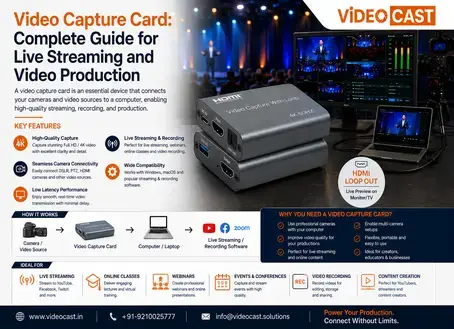
Capture Card or Streaming Encoder
↓
Streaming Computer
↓
Online Platform
The switcher creates the program feed while the streaming system handles encoding and online delivery.
Applications of Video Switchers
Corporate Events
Switch between speakers, presentation screens, cameras, and promotional videos during business events.
Conferences
Combine keynote speakers, panel discussions, presentation content, and audience shots.
Concerts and Performances
Use multiple camera angles to create dynamic coverage of the stage.
Worship Production
Switch between speakers, musicians, presentations, and wide venue shots.
Studio Production
Manage multiple cameras, media sources, graphics, and other inputs from a centralized location.
Live Webinars
Choosing a Video Switcher for Your Production
The best video switcher depends on the complexity of your workflow.
Number of Inputs
Choose enough inputs for your current sources and allow room for additional equipment.
Video Interfaces
Check whether your cameras and devices use compatible HDMI, SDI, USB, IP, or other supported connections.
Resolution
Make sure the switcher supports the required video resolution and frame rate.
Transition Options
If smooth transitions are important, review the switching effects supported by the model.
Multiview
A multiview function can make it easier to monitor multiple sources during live production.
Outputs
Check that the available outputs match your monitors, streaming encoder, recorder, capture card, or other equipment.
Expansion
If your production is likely to grow, selecting a switcher with additional inputs and useful production features can reduce the need for an early upgrade.
VIDEOCAST Video Switcher Solutions
VIDEOCAST provides professional video production equipment for live streaming, broadcasting, events, and multi-camera production.
Its video switcher solutions can be integrated with PTZ cameras, wireless video transmitters, PTZ controllers, capture cards, and other production equipment to create flexible live workflows.
Explore the VIDEOCAST video switcher category for professional production solutions.
Conclusion
A video switcher simplifies complex live production setups by bringing multiple video sources into a centralized workflow. Instead of managing cameras, presentations, and media independently, production teams can monitor and select sources from one system.
When combined with PTZ cameras, PTZ controllers, wireless video transmitter, capture cards, streaming computers, and recording equipment, a video switcher can form the core of an efficient multi-camera production environment.
For the best results, select a switcher based on your number of sources, video formats, resolution, outputs, monitoring requirements, transition features, and future production needs.
Frequently Asked Questions (FAQs)
1. What does a video switcher do?
A video switcher allows an operator to select and switch between multiple video sources during a live production.
2. Can a video switcher handle multiple cameras?
Yes. Compatible video switchers can accept feeds from multiple cameras and allow operators to select the required camera for the program output.
3. Can I use a video switcher for live streaming?
Yes. A switcher can create the final program feed, which can then be sent to compatible capture or streaming equipment.
4. Can PTZ cameras be connected to a video switcher?
Yes. Compatible PTZ cameras can provide video feeds to a switcher while their movement and zoom are controlled through a PTZ controller or software.
5. What is multi view monitoring?
Multiview allows multiple video sources and production outputs to be displayed simultaneously on one monitoring screen.
6. Can a video switcher handle presentations and cameras together?
Yes, provided the switcher has compatible inputs. A production can combine camera feeds, laptops, presentation systems, and other supported sources.
7. What is picture-in-picture?
Picture-in-picture places one video source inside another, such as showing a presenter in a smaller window while presentation content occupies the main screen.
8. Where are video switchers commonly used?
They are commonly used for live streaming, broadcasting, conferences, corporate events, concerts, worship services, studios, webinars, and multi-camera productions.


Comments